Many of life’s secrets are unveiled to us as a rite of passage. Traditionally, women have shared their experiences with their daughters and granddaughters so they know what to expect from their bodies, their families, and their future. But there’s one secret that often goes unmentioned: the importance of strong pelvic floor exercises and how they can significantly impact your quality of life in your later years.

Why is a strong pelvic floor important?
Picture this: You’re standing in public, chatting with your girlfriends. Karen says something hilarious, and you all roar with laughter. Only…that’s not the only thing that escaped you. Clutching your belly in mortified shock, you can’t believe that you just peed yourself.
Did anyone notice? Why did that happen? What’s wrong with you?
Well, in truth, there’s nothing wrong with you. You just haven’t built up your core muscles or developed a strong pelvic floor. It’s a common issue amongst women, but one that no one wants to discuss.
Your pelvic floor consists of several muscles and acts as a hammock at the bottom of the pelvis. These muscles provide support to the abdominals and organs. When all these muscles are healthy, they can be controlled, but if they become weak, they can cause bladder and bowel control loss.
If your pelvic floor muscles are not strengthened properly, it leads to urinary incontinence, and you may find yourself needing to go to the toilet more often than normal. Worse still, you may involuntarily release urine when pressure is put on your bladder. This can happen when you laugh, cough, sneeze, run, or jump.
With the frequency that you commit these acts, peeing yourself every time you do really isn’t an option you want to put up. Thankfully, it’s a condition that is easily reversed or prevented in the first place.
How to Build a Strong Core and Pelvic Floor Over 50

What is pelvic floor weakness or dysfunction?
Pelvic floor dysfunction is a wide range of disorders that occur when pelvic floor muscles are weak, tight, or torn. If the muscles become weak or the ligaments or tissues are stretched or damaged, the pelvic organs or small intestine may drop down and protrude into the vagina. This is known as prolapse and can cause significant pain, discomfort, and other health problems.
Common causes of a weakened pelvic floor include pregnancy, childbirth, prostate cancer treatment in males, obesity, and the associated straining of chronic constipation.
Who is affected by Pelvic floor dysfunction?
Lack of knowledge on the importance of building and maintaining a strong pelvic floor is a widespread problem. As a result, between 12 – 25 million Americans suffer from pelvic floor dysfunction and bladder problems.
It’s also worth noting that whilst 1 in 3 women suffer from some form of pelvic floor dysfunction, only half seek any help.
Urinary incontinence can happen to women at any age, but it is more common in older women. More than 4 in 10 women 65 years and older have urinary incontinence.

What is bladder disease?
There are various forms of bladder disease. These include but are not limited to:
- Cystitis – Inflammation of the bladder, often from an infection.
- Urinary incontinence – loss of bladder control.
- Overactive bladder – when the bladder squeezes urine out at the wrong time.
- Interstitial cystitis – a chronic problem that causes bladder pain and frequent, urgent urination.
For more information on bladder problems and how to treat them naturally, check out my earlier interview with Lisa King.
What foods irritate your bladder?
Now that we’ve opened up the discussion on this hot secret, it’s time to look at what you can do to prevent it or stop it from occurring. Taking care of your core muscles and building a strong pelvic floor is easier than you think. The first step, as always, is to look at your diet.
Foods and drinks that irritate your bladder and cause urinary tract infections, inflammation, irritation, and more frequent toilet trips tend to have high acidity. These include but are not limited to:
Alcohol, apples, carbonated beverages, chocolate, citrus juice and fruits, coffee and tea, corn syrup, cranberries, spicy foods, honey, milk, sugar and artificial sweeteners, tomatoes, and vinegar.
Drink plenty of water during the day to avoid building acidity in the bladder. Limiting water may result in fewer bathroom trips, but the smaller amount of urine is highly concentrated and irritates the bladder. Studies suggest limiting your liquid intake to eight glasses daily and spacing it out over the course of the day. Try not to drink a lot in the hours before bedtime and leave around 2 hours between your last drink and going to sleep.
Furthermore, it’s worth noting that while cranberries and cranberry juice have built up a bit of a reputation as the go-to natural treatment for urinary infections, they can do more harm than good. Sadly, cranberry has a higher acidity content than many other fruits. Be mindful when ingesting them and if you notice more frequent toilet trips afterward, do your bladder a favor and cut them out of your diet.

How to Build a Strong Pelvic Floor with Effective Exercises
Building a strong pelvic floor is easier than you might think. It’s about working the core group of muscles as a unit. Your core comprises abdominals, hips, back, gluteals, and pelvic floor muscles, and the nerves that activate those muscles.
Exercising them together builds a unified, strengthened pelvic floor that can easily control the bladder and bowel.
What is a Kegel?
Kegel is an exercise developed in the late 1940s by Dr. Arnold H. Kegel, an American gynecologist, as a nonsurgical way to prevent women from leaking urine.
It helps strengthen the pelvic floor, which supports the uterus, bladder, small intestines, and rectum. You can do Kegel exercises, also known as pelvic floor muscle training, anytime. To find the pelvic floor muscles, you also need to know how to relax them and what the difference feels like.
Kegel exercises work the internal muscles, so there’s no hope of gaining a six-pack from them! But it will strengthen your core, improve your posture, aid your balance, reduce lower back pain, and improve bladder control.
How to do a Kegel
It’s so simple to do Kegels that you can practice them anytime and anyplace. They’re perfect for sitting at your desk, on the bus, or watching a film. Once you’ve mastered them, you can do them whilst walking too! I’m even doing them while writing this!
However, you don’t want to make a habit of practicing them on the toilet. That is to say, starting and stopping your urine flow midstream is an indicator of pelvic floor strength. But, continuously doing so can lead to incomplete emptying of the bladder. This increases the risk of urinary tract infections.
Here’s how to do it:
- Start by emptying your bladder.
- Lie on your back, knees bent.
- On an exhaled breath, tilt your pelvis slightly upwards. As you do, tighten and pull the pelvic muscles upwards. Imagine pulling an elevator inside the vagina up towards your belly button. You’ll feel the muscles contract and it feels a little like holding in a pee and a poo at the same time! You should NOT feel tightness in your hamstrings and, done correctly, can’t see any movement externally.
- Tighten the pelvic floor muscles and hold for 10 seconds
- Relax the muscles completely for 10 seconds
- Do 10 – 15 repetitions 3 – 5 times per day or whenever you have time
Doing Kegels frequently yields results in just a few weeks or months, depending on what’s going on with our bodies. It reduces urine leaks and bladder irritation and creates a strong core and pelvic floor.
What to avoid when you exercise
Bad habits you might have could also be contributing to your poor bladder control. Make sure you follow best practices when exercising.
- Don’t hold your breath
- Keep good posture
- Don’t tighten your abdominals from the outside
- Do core exercises that are not too hard for you. Overexercising may cause leaking.
Exercises to avoid (until months after practicing Kegel)
Some exercises that can cause bladder leakage should be avoided until you have spent some time building a strong pelvic floor. These include:
- Running and jumping. This can easily be replaced with the elliptical in the interim.
- Heavy weights with few repetitions.
- Double leg lifts (double leg lift and lower).
- Sit-ups with straight legs in the air (Teaser).
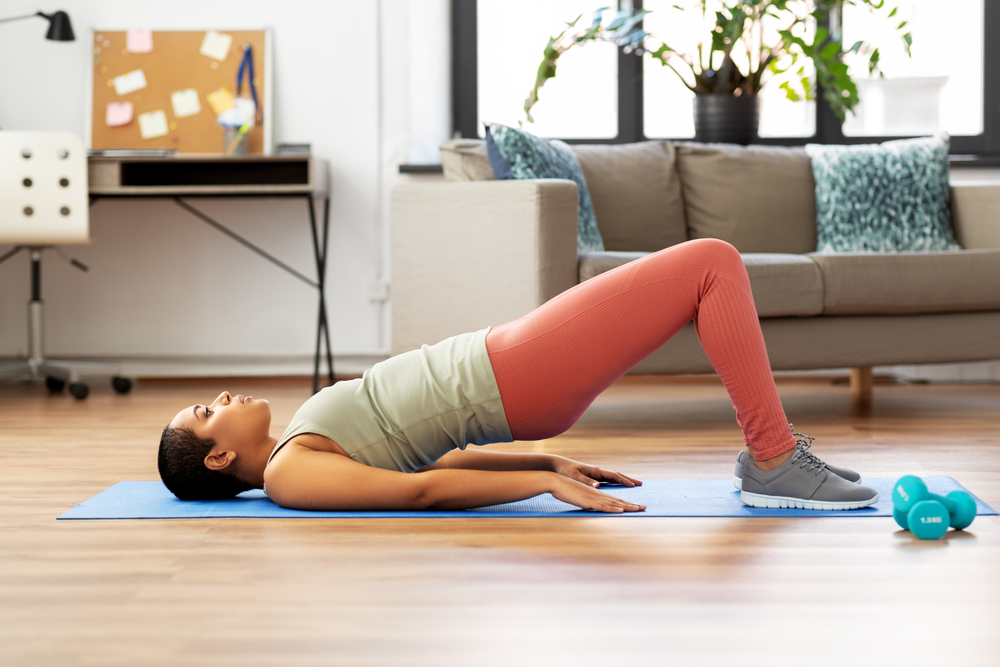
How to build a strong core and a healthy pelvic floor
As well as Kegels, you can do other strong pelvic floor exercises to help build strength and support your core muscles.
If you’ve started to leak, don’t be embarrassed—take action by starting with the exercises below. Be consistent and do them every day to see results. If your condition worsens or you experience noticeable pain while urinating, be sure to consult your doctor.
Ideally, you should engage your pelvic muscles before you start the exercise and then release them afterward.
- Bridge (use a ball between your legs)
- Alternating marches or toe taps
- Supine alternating leg side-to-side bend/knee folds (one leg opens)
- Spine Twist
- Side Plank
- Bird Dog
If you’ve been following along on my YouTube video workouts, you’ll know how to do these exercises. But if not, no worries. You can watch the video below and follow along with me as I demonstrate each step.
In Conclusion
Pelvic floor dysfunction is a seemingly embarrassing problem that women don’t talk about. But, you know what? It’s more common than you realize, and nothing is shameful.
It’s time to get to know your body. Recognize symptoms. And take control of your health by building a strong core and pelvic floor. You can do this, ladies!
I always love these healthy reminders to keep that pelvic floor strong! Good job!
Thank you, Rebecca. Pass on this information to anyone you know that can benefit from the tips and strategies I am sharing.
This is excellent! A very comprehensive post. About 10 years ago, I had severe burning and pain and was trying to figure out what was wrong. I thought perhaps IC, but found that I had pudendal neuralgia, which was from tight muscles impinging n the pudendal nerve in the pelvis. More the oppositve of a loose pelvic floor. I do work on my core and do bridges as well.
jess xx
http://www.elegantlydressedandstylish.com
Hi Jess. You are most welcome and thank you for sharing your story. The more we know the better we can help each other.
Heike,
Great post!
I would love to share this on my online magazine if you are interested in being a collaborator!
https://www.influencersofmidlife.com
Hugs,
Robin
Thank you, Robin. Yes, I would love to share this with your online magazine. Let me know the next steps.
What a great and informative post
Thank you, Darcy glad you stopped by and I could help.
Pingback: 5 Tips For A Strong and Lean Core For Women Over 50s
Comments are closed.